
Object description
This elegant maiolica tazza a maiolica tazza refers to a decorative or serving dish, popular during the 15th and 16th centuries in Italy, featuring vibrant, often narrative scenes (istoriato). Attributed to Deruta and dating from around 1500–1525, this plate captures a moment of quiet beauty, a bella donna (beautiful woman) in profile, gently smelling a flower. Inspired by Renaissance imagery, her likeness may even echo drawings by Pintoricchio, revealing how artists borrowed and reimagined visual ideas across media.
Encircled by ‘dog-tooth’ (or sunburst) and stylised floral motifs, the design reflects both artistic skill and symbolic richness, while the finely glazed surface speaks to the technical mastery of Italian maiolica.
Through careful study, from decorative details like the distinctive “dog-tooth” motif to comparisons with historic collections. This object continues to reveal new insights.
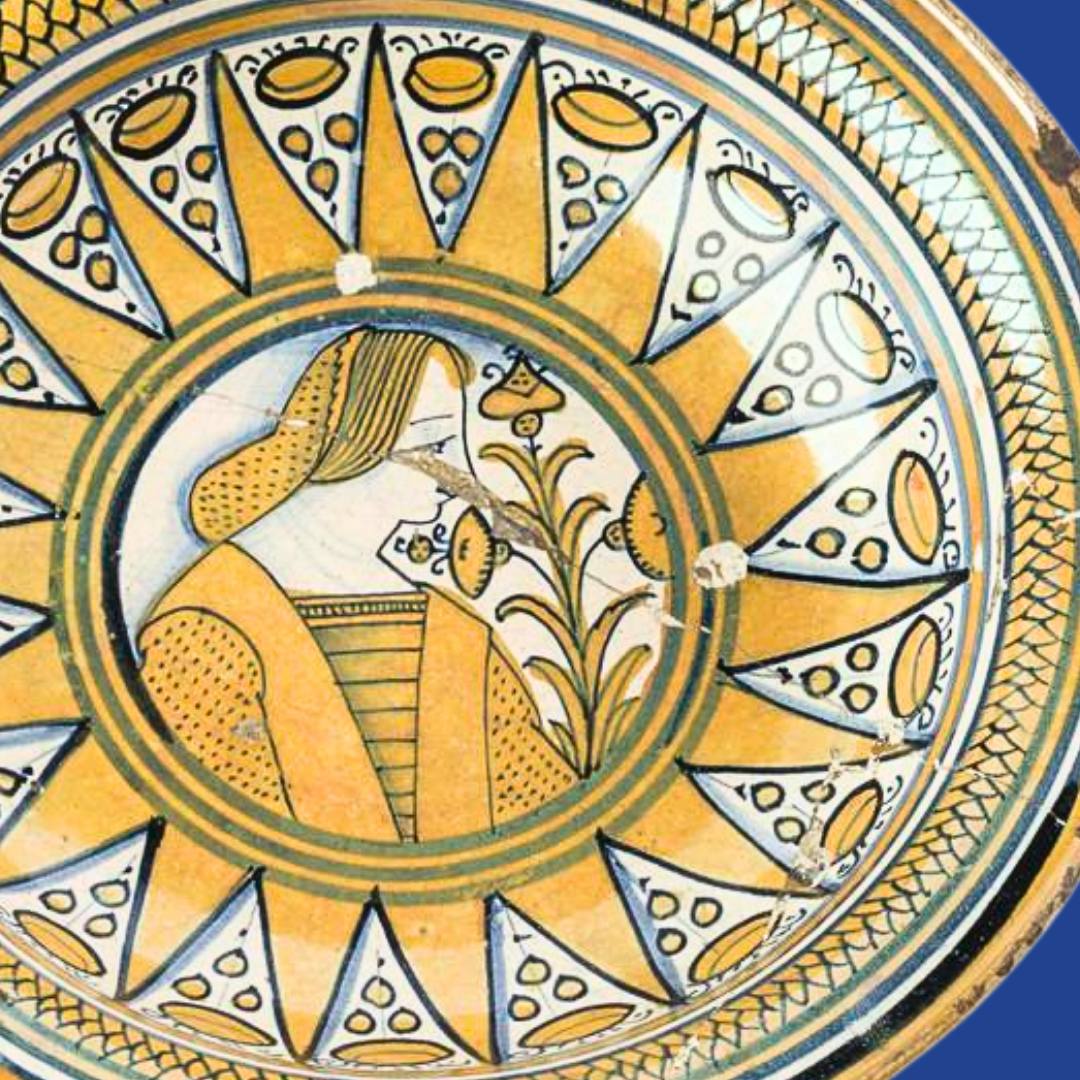
Feature Image: Lustre Maiolica Tazza (plate) | Ceramic ,Maiolica | 15th century AD | Hunt Collection 1
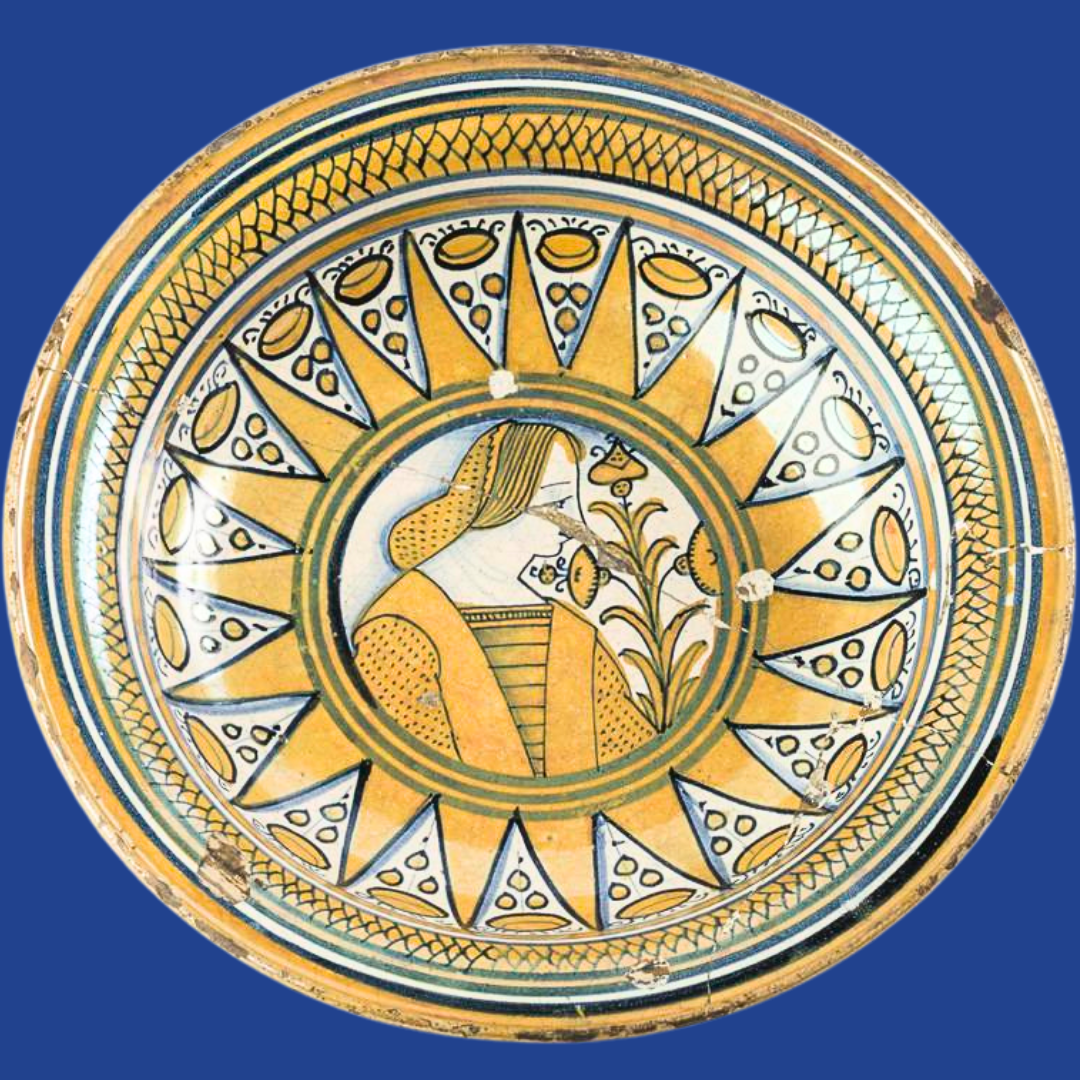
Feature Image: Lustre Maiolica Tazza (plate) | Ceramic ,Maiolica | 15th century AD | Hunt Collection 2
About ‘dog-tooth’ or sunburst motif
The “dog-tooth” (or sunburst) motif seen on this maiolica tazza is more than decorative, it is a key feature in understanding both the object’s date and place of production.
In Italian Renaissance ceramics, particularly those from Deruta, this radiating triangular pattern became popular in the late 15th and early 16th centuries. Its rhythmic, pointed forms echo both solar imagery and earlier geometric traditions, symbolising light, vitality, and divine presence, themes closely aligned with Renaissance humanism.
Art historians often use the dog-tooth motif as a diagnostic detail, helping to attribute works to specific workshops or regions. In this case, its style supports a dating of around 1500–1525 and strengthens the connection to Deruta’s distinctive ceramic tradition.
Beyond its technical importance, the motif also enhances the central image, drawing the viewer’s eye inward, almost like rays of light, toward the bella donna, reinforcing the sense of focus, beauty, and contemplation at the heart of the piece.
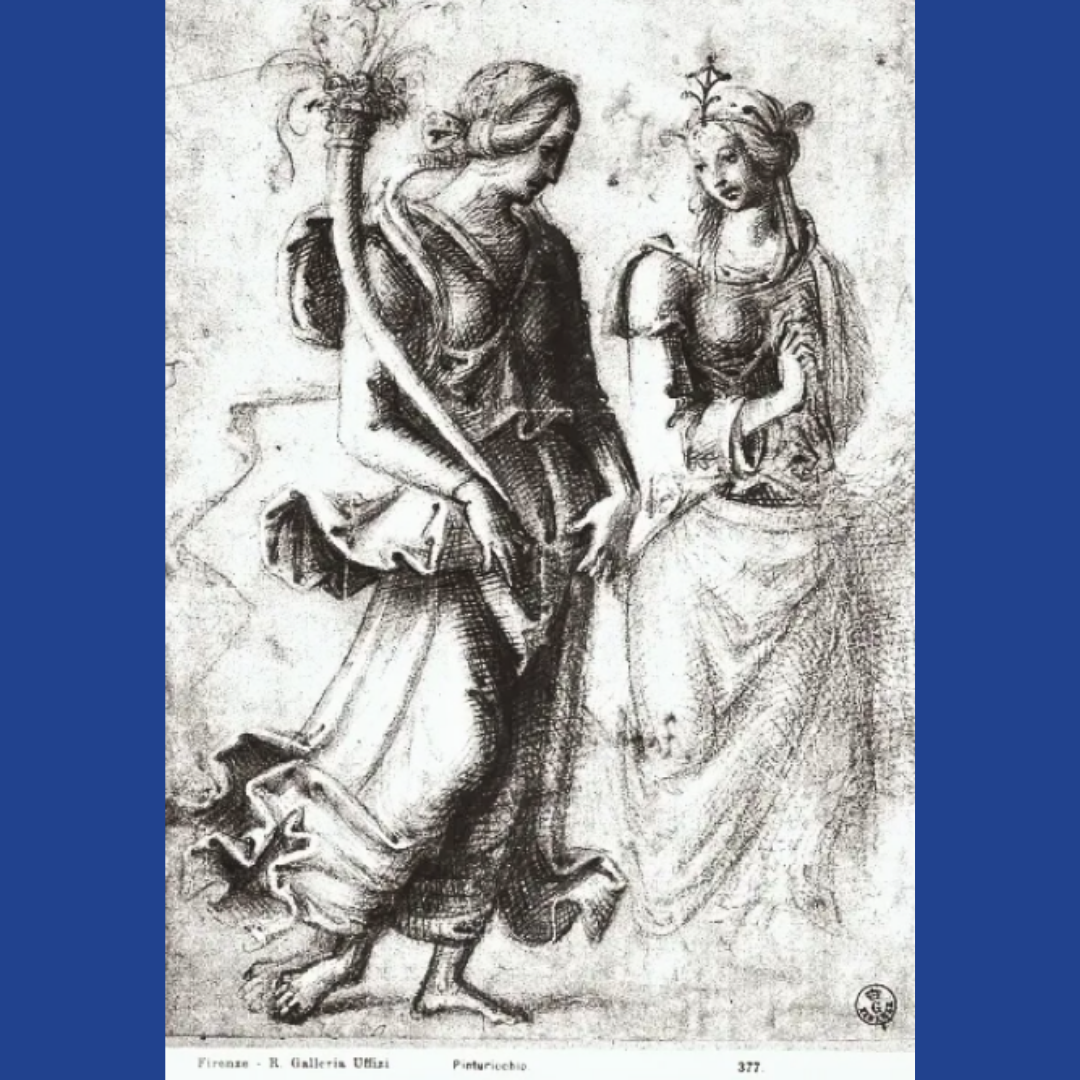
Two allegorical figures, 1474-1513 AD, by Pinturicchio, Bernardino di Betto, in the Gabinetto dei Disegni e delle Stampe, at the Uffizi Gallery, Florence Florence Uffizi Gallery, Gabinetto dei Disegni e delle Stampe Drawing High Renaissance. Image courtesy of © Alinari Archives, Florence
About Pintoricchio
Bernardino di Betto, known as Pintoricchio (or Pinturicchio, c.1454–1513), was an Italian Renaissance painter from Perugia. A prolific fresco decorator, he was noted for his refined color, intricate ornament, and storytelling clarity that bridged the late Gothic and High Renaissance styles. His works embody the elegance of the Umbrian school and influenced later painters including Raphael. Pintoricchio’s art combined narrative clarity with ornamental richness—figures set amid bright landscapes, gilded decoration, and architectural fantasy. Though sometimes overshadowed by contemporaries such as Perugino and Raphael, he contributed to spreading Renaissance ideals beyond Florence and Rome. His preserved frescoes in Siena, Spello, and the Vatican continue to exemplify the decorative splendor of the Umbrian Renaissance.