Through the 3DBigDataSpace project the Hunt Museum is delighted to offer museum and cultural heritage professionals with training to make the leap into cultural heritage 3D digitisation, modelling and fabrication.
To do this, we have partnered with:
- PhD researcher, Tadhg Charles who is using these emergent technologies and co-design processes with disability groups, to create tactile displays in museums that benefit all visitors.
- Digital Repository of Ireland (DRI) who will provide an overview in metadata standards, licencing, 3D model deposit in public and institutional repositories and in 3D collection preservation.
Why offer this training?
3D digitisation has revolutionised the world of cultural heritage, making collections and heritage sites digitally accessible to everyone who has a digital device. But the benefits of 3D digitisation do not stop there. 3D objects can be fabricated to deliver rich tactile experiences. These increase collections based access for all visitors, including those who are blind or have limited vision.
For museum and cultural heritage professionals looking to enter the realm of 3D digitisation space, it can be very daunting. Therefore, this modular training programme will walk them through the fundamentals, providing hands-on experience in 3D object capture and modelling, and providing insight and guidance into object fabrication options, as well as 3D storage, management, sharing and depositing and much more.
Who is this training for?
This training is geared towards museum professionals, such as curators, access officers, learning staff, exhibition designers, conservations, who are new to 3D capture. Participants need strong digital skills to get the most out of this opportunity. Participation/attendance at each training is strongly encouraged but not essential.
Training Dates:
Session 1: Capture & Practical Foundations
Training format: In Person
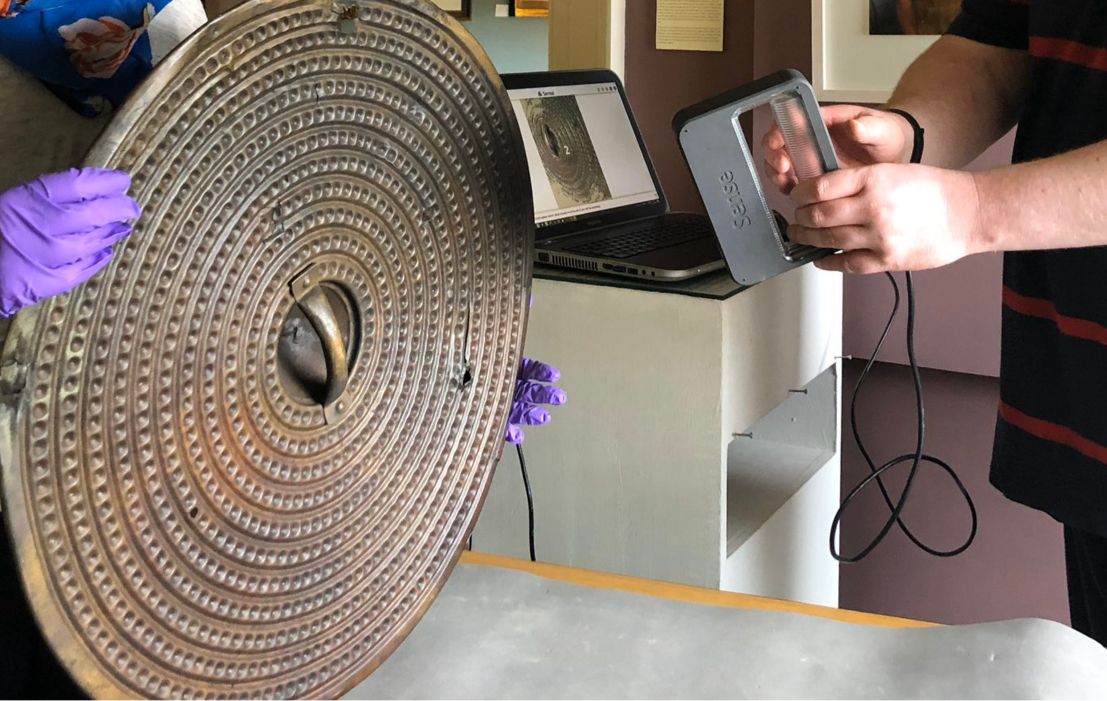
This is a practical, full day workshop introducing participants to photogrammetry, 3D scanning methods, digital mesh review, slicing basics for 3D printing and tactile prototype testing. Please note that lunch is not provided.
Wednesday, 29 October 2025, 11am to 7pm – BOOK NOW
Session 1: Capture & Practical Foundations
Join the live stream for the above in person workshop to access demonstrations and much more – BOOK NOW
Session 2: From Mesh to Model
Training Format: Online
Session participants will learn how to clean, repair and adapt raw scans into tactile-ready 3D models using open source tools and best practice editing workflows. Includes a live demo in Blender/Meshmixer and a guided peer review so participants can prepare a cleaned file for printing.
Tuesday, 11 November 2025, 6pm to 9pm – BOOK NOW
Session 3: Fabrication Methods & Materials
Training Format: Online
Session participants will learn how to translate cleaned models into physical objects. It will cover: slicing strategies, material choices, safety and finishing for tactile display.
Tuesday, 25 November 2025, 6pm to 9pm – BOOK NOW
Session 4: Inclusive Design & Tactile Communication
Training Format: Online
Session participants will learn the basics on how to design tactile models and exhibition displays that communicate meaning clearly. Interpretative approaches will be tested by blind and visually impaired contributors.
Tuesday, 9 December 2025, 6pm to 9pm – BOOK NOW
Session 5: Documentation & Licensing & Deposit
Training Format: Online
Led by the Digital Repository of Ireland (DRI) with Tadhg Charles. Participants will learn how to document 3D models, including metadata standards, choose responsible licences, such as Creative Commons and how to deposit models in institutional or public repositories, including the DRI. The session will conclude with some tips on preserving and sustaining 3D collections for the long term.
Tuesday, 13 January 2026, 6pm to 9pm – BOOK NOW
What equipment do I need?
All participants need is a stable WIFI connection, a laptop with browser and webcam and a smartphone with camera (for practical activities).
Please note:
Participants attending the In Person session: Capture & Practical Foundations, on October 29th, can bring (optional) a small non-sensitive and robust object with them to use during scanning.
How will the training be delivered?
The training format will be blended.
Session one will be an in-person session at the Hunt Museum. This session will also be live streamed.
The four subsequent training sessions will be online, from 6pm to 8pm, with an optional tutorial hour from 8pm to 9pm.
These training sessions will include mini-lectures, demonstrations and simple group work tasks.
Links for prework materials will be supplied to participants in advance of each session. These include 15-30 minute videos, case studies, checklists, cheat sheets, templates.
Participants will be asked to do a small amount of homework between training sessions but this is optional.
Accessibility & Consent
Access and Consent – In-Person Sessions (what to expect)
We are committed to making in-person training accessible to everyone. For the in-person day (Capture & Practical Foundations) we provide:
- Step by step to stop access to the training workflow.
- Live captioning and a printed transcript of key presentations on request.
- Requests for Braille or large-print handouts must be made at least 7 days before the session.
- Hands-on tactile demonstrations and structured tactile testing with trained access consultants.
- Health & safety guidance for fabrication demos. Support from a co-facilitator to assist with in person access requirements during activities.
Consent and recording (in-person)
We will record parts of the in-person day for research and reflection (audio and video) only with your prior consent. If you do not consent to recording, you can still participate fully please tell staff on arrival or indicate your preference on the registration/consent form. Photographs of group activities (no close-ups) may be used for project dissemination; we will not publish identifiable images of anyone without explicit permission.
Access and Consent – Online Sessions (what to expect)
Online sessions are designed to be accessible, interactive and inclusive:
- Live captioning will be provided for all online sessions (via Microsoft Teams).
- A searchable transcript will be shared after each live session.
- Short pre-session videos (15–30 mins) and a written checklist are provided as required before each workshop to make live time efficient.
- All videos will include captions and transcripts where necessary.
- Handouts (slides, templates) are available in accessible PDF and large-print formats. (Braille versions available on request.)
- We encourage camera-on for engagement but you may participate off-camera or by audio only if preferred.
Consent & recording (online)
Online sessions will be recorded for research and quality-assurance purposes with explicit consent at registration.
You can:
(a) consent to recordings for internal research only,
(b) consent to recordings and anonymised extracts being used in public outputs. You may opt out of recordings at any time and still complete the course. All recordings, chat logs and uploaded files are stored securely and handled under institutional GDPR and research ethics procedures.
Participant Learning Validation
The Hunt Museum, as part of the 3DBigDataSpace project, is contractually obligated to validate learning. Therefore participants will be required to complete:
- A pre and post training survey
- A short quiz, survey or paragraph reflecting on their learning at the end of each session
Digital files* produced by participants during training sessions will also be used to gauge the degree to which learning objectives have been achieved.
These include:
- Object photos (JPEG), raw scans (PLY/OBJ), processed meshes (STL), sliced project files.
- Metadata record (CSV/JSON) per 3D model.
Registration policy & consent:
By registering you agree to participate in research activities associated with this training. Recordings, files and survey data will be retained for research with participant consent. You may opt out of public sharing of any specific model. Contact tadhg.charles@northumbria.ac.uk for data queries.
Privacy & data handling: All data handling follows institutional GDPR and research ethics guidelines. Personal data is retained separately from model files; model metadata can be anonymised prior to research outputs.
Cancellation policy: Please notify in advance if you cannot attend to release your place.
Organisers reserve the right to reschedule if necessary.